Pearson Edexcel · GCSE · Business
Course version: 1BS0 · Version from Sept 2017
Calculation and interpretation of: ● gross profit margin ● net profit…
Full specification wording
Business calculations: Calculation and interpretation of: ● gross profit margin ● net profit margin ● average rate of return.
Profit margins measure how efficiently a business turns sales into profit, expressed as a percentage.
Checked against the Pearson Edexcel 1BS0 specification (opens in a new tab) on .
- Point 2 of 2
- 3 key terms
Study notes
From the checked teaching notes for this specification point.
The idea
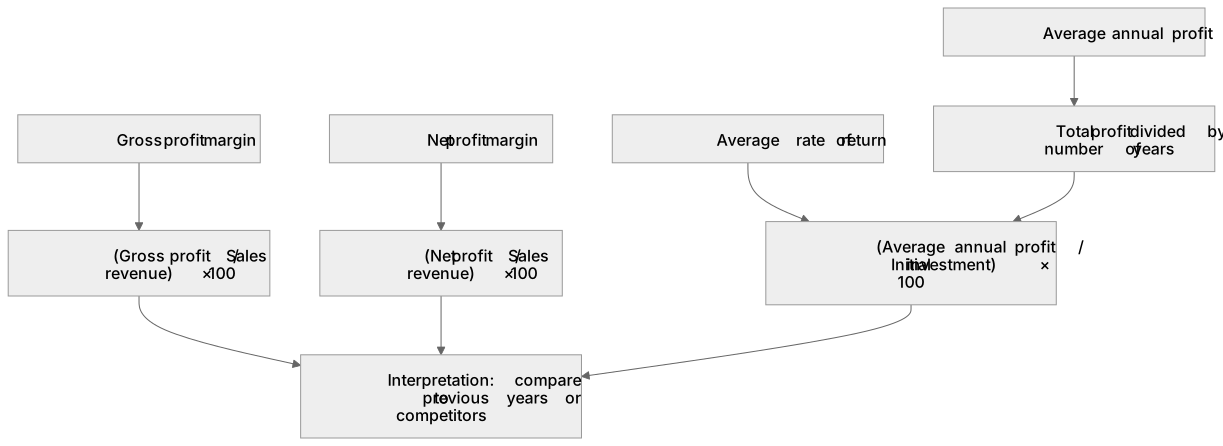
Profit margins measure how efficiently a business turns sales into profit, expressed as a percentage. Gross profit margin is calculated as (gross profit / sales revenue) × 100, showing the revenue retained after direct costs. Net profit margin is (net profit / sales revenue) × 100, revealing profitability after all expenses. For instance, a 15% net profit margin means 15p of every £1 earned is profit. Average rate of return (ARR) evaluates investments by comparing average annual profit to the initial cost: (average annual profit / initial investment) × 100. Interpreting these figures helps managers compare performance over time or against competitors, and decide whether a new project is financially worthwhile.
What earns the marks
- Gross profit margin formula: (Gross Profit / Sales Revenue) × 100.
- Net profit margin formula: (Net Profit / Sales Revenue) × 100.
- Average Rate of Return (ARR) formula: (Average Annual Profit / Initial Investment) × 100.
- To find average annual profit for ARR, subtract the initial investment from total project cash inflows to find total profit, then divide by the number of years.
- Interpreting margins involves comparing them to previous years or competitors to assess financial efficiency and cost control.
Common mistakes and how to put them right
Forgetting to multiply by 100.
Put it right by ensuring all margin and ARR calculations are converted into percentages.
Calculating ARR using total profit instead of average annual profit.
Put it right by dividing the total lifetime profit by the number of years the project runs.
Confusing the denominator in margin calculations.
Put it right: Divide the profit figure by sales revenue, not by total costs.
Exam tips
- When interpreting margins, state clearly whether an increase or decrease is positive for the business and suggest a possible reason, such as lower supplier costs.
- For ARR questions, carefully check if the data provides total profit or total cash inflow; if it is inflow, remember to subtract the initial cost first.
- Always write the % symbol in your final answer for margins and ARR to ensure full marks.
Try the lesson
The start of the Business calculations: Calculation and interpretation of: ● gross profit margin ● net profit margin ● average rate of return. lesson, made from checked teaching notes for this specification point.
Have a go first
A furniture manufacturer has a total sales revenue of £200,000 and a gross profit of £50,000. What is the gross profit margin for the business?
Listen
Profit margins measure how efficiently a business turns sales into profit, expressed as a percentage. Gross profit margin is calculated as (gross profit / sales revenue) × 100, showing the revenue retained after direct costs. Net profit margin is (net profit / sales revenue) × 100, revealing profitability after all expenses. For instance, a 15% net profit margin means 15p of every £1 earned is profit. Average rate of return (ARR) evaluates investments by comparing average annual profit to the initial cost: (average annual profit / initial investment) × 100. Interpreting these figures helps managers compare performance over time or against competitors, and decide whether a new project is financially worthwhile. A strong answer earns marks for these points. Gross profit margin formula: (Gross Profit / Sales Revenue) × 100. Net profit margin formula: (Net Profit / Sales Revenue) × 100. Average Rate of Return (ARR) formula: (Average Annual Profit / Initial Investment) × 100. To find average annual profit for ARR, subtract the initial investment from total project cash inflows to find total profit, then divide by the number of years. A common slip: Forgetting to multiply by 100. Instead, ensuring all margin and ARR calculations are converted into percentages. Exam tip: When interpreting margins, state clearly whether an increase or decrease is positive for the business and suggest a possible reason, such as lower supplier costs.
See it
Key words
Say what each word means before you turn the card.
Gross profit margin
Try answering aloud or in your head before turning the card.
Net profit margin
Try answering aloud or in your head before turning the card.
Average rate of return
Try answering aloud or in your head before turning the card.
See every definition
- Gross profit margin
- Calculated as (gross profit / sales revenue) × 100, showing the revenue retained after direct costs.
- Net profit margin
- Calculated as (net profit / sales revenue) × 100, revealing profitability after all expenses.
- Average rate of return
- Evaluates investments by comparing average annual profit to the initial cost: (average annual profit / initial investment) × 100.
Label the diagram
Some boxes have lost their names. Pick the right name for each number.
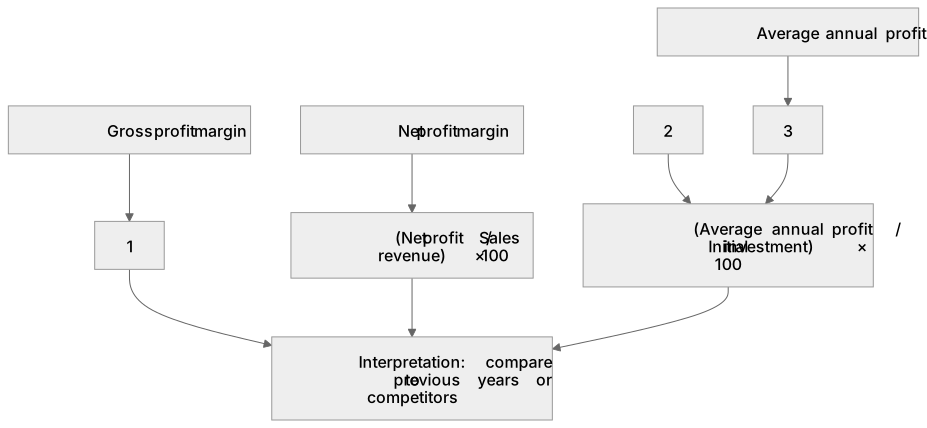
1Box 1
2Box 2
3Box 3
There is more to this lesson
The full lesson goes on to check your understanding and help you earn the marks. Create a free account to carry on, with your progress saved.
A week of Premium from your first lesson · Then the free plan continues · No card, no charge
Test your understanding of Business calculations: Calculation and interpretation of: ● gross profit margin ● net profit margin ● average rate of return.
Active recall beats re-reading. Take an instant quiz now to test what you’ve learned and lock it into long-term memory.
A week of Premium from your first lesson · Then the free plan continues · No card, no charge